
December 15, 2025
How to Protect Yourself When Renting a Timeshare Stay
Venturing into the world of timeshare rentals can offer an exciting and cost-effective way to experience luxurious vacation destinations. However, becoming educated about the process is an important step towards not only securing the best price for your rental, but ensuring you are protected throughout the transaction.
In this article, we review the due diligence that a renter should perform in order to ensure they are securing a legitimate timeshare stay. From verifying the legitimacy of the rental source to understanding the nuances of your agreement, we aim to arm you with the knowledge needed to make informed decisions, protect your funds, and ensure a hassle-free vacation experience.
Why Timeshare Rentals? The Best-Kept Secret in Family Travel
Timeshare rentals are a great, affordable option for many vacationers. Timeshare condos are known for offering amenities beyond typical hotel rooms, such as:

In-Unit Amenities
- Full Kitchens
- In-Unit Laundry
- Separate Bedrooms
- Spacious Living Areas
- Private Balconies or Patios
Resort Shown: Disney’s Saratoga Springs Treehouse – Kitchen Area

Resort Amenities
- BBQ Grills and Picnic Areas
- Recreational Facilities
- Personal Concierge Services
- Clubhouses and Social Areas
- On-Site Grocery or Convenience Stores
Resort Shown: Marriott’s Grande Vista – Pool Area
In this sense, timeshares offer the best of the comfort you have in your home, without sacrificing the service and hospitality of the hotel experience. It is therefore not surprising that renting a timeshare condo is a preferred option for many families seeking to vacation in a comfortable spacious environment.
Booking A Timeshare Rental
Timeshare rentals are mostly booked directly from owners and brokers, directly or through dedicated marketplaces. Unlike booking from a large hotel chain like Marriott, Hyatt or Hilton, guests secure their stay through an alternative venue and therefore need to do careful research to ensure the legitimacy of the rental source.
After all, no one wants to show up in a far away, often foreign resort, with their family and suitcases only to find out they don’t have a place to stay!
The most important due diligence is verifying that you are renting from a legitimate rental source. If the website that you are using to contact the owner or broker is simply a marketplace for connecting the two parties, even if it is established and reputable, it is still just a marketplace. The guest should still perform due diligence verifying that the landlord is a legitimate owner or broker.
Important business credentials in the timeshare industry include the following:
- a real estate license that can be verified in the state where it was issued
- consistent reviews from reputable sites and customers
- a Better Business Bureau rating and/or accreditation for the business
If you are seeking to rent directly from an owner who does not have such credentials, it is even more important to request documentation from the owner proving that they own the specific resort and reservation.
Ask for full contact information from the owner and do not shy away from speaking with them directly on the phone. Ask them questions about the ownership and the resort. Ask if they rented their week previously and if they have references you can speak to. Request to see a copy of the reservation.
And ensure you protect your funds – which is what we will discuss next.
One way to protect your funds is to use an escrow service. If you are renting through a licensed company/brokerage firm or marketplace that offers verified guaranteed listings, this service may already be included.
If, however, you are renting from a private owner consider using a third party escrow service that will hold the funds and pay the owner upon your checkout from the rental unit. Many closing companies that offer timeshare resale closing services will also offer an escrow service for rental funds.
It is highly recommended to always use a rental agreement to specify the terms and conditions of the rental. Regardless if you are renting from an owner or an established company, it is ideal to have written terms and conditions that clearly specify certain key factors.
The specifics of the rental should include at a minimum:
- the name / address of the resort
- unit size
- view
- check in / check out dates and times
- number of guests allowed
- pricing
- payment methods and timelines
- cancellation / reservation change policy
If you’d like to explore each of these elements in detail to give you some insight on what to expect from reviewing a well-crafted timeshare rental agreement, you can read our article here: Timeshare Rentals 101: Understanding Timeshare Rental Agreements.
Timeshare Rentals 101: Understanding Timeshare Rental Agreements
An important aspect to be aware of is that RCI and Interval International do not allow rental of weeks obtained through exchange services. If your resort confirmation for the vacation is coming in the form of an RCI guest certificate or Interval International confirmation, in 99% of the cases this rental is not allowed.
There are however certain exceptions for owners that have a home resort that can only be booked through the exchange company. For example, certain ownerships at Divi resorts or Grandview Las Vegas are set up as RCI ownerships where the home resort is booked through RCI by the owner. However these cases are rather the exception and not the rule.
To avoid surprises at checkout, ask the owner to clarify any taxes and charges that are not included in the rental price. It is not uncommon for a guest to pay certain charges at checkout which may include local lodging and excise taxes, housekeeping / cleaning fees, energy taxes, parking fees or other resort fees.
For example, guests in Hawaii could pay lodging taxes at checkout, and in Aruba, energy surcharges are typical. Ideally the rental agreement should specify all taxes and fees not included in the rental price that are due payable at the resort.
For Red Timeshares rental listings, you can see any applicable taxes and fees displayed in a transparent manner, even before booking your stay.
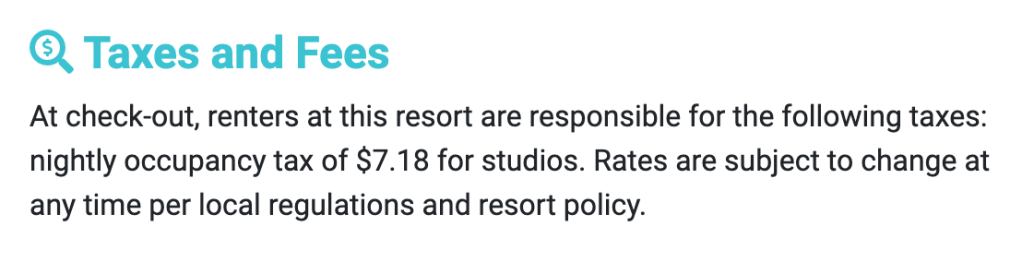
If you’d like to learn everything you need to know about taxes, fees, & charges when renting a timeshare to avoid surprises, be an informed traveler and check out our article here: Understanding Taxes, Fees and Charges When Renting a Timeshare Stay.
Understanding Taxes, Fees and Charges When Renting a Timeshare Stay
Unlike the rental of a home or apartment from a private homeowner, which has a guaranteed location and furnishings, timeshare units are generally assigned by the resort management team at the time of check in. In some cases, a guest may be renting a fixed unit which guarantees a floor and unit location and a clearly defined view.
But in many cases a guest will be renting a specific unit size and view category, while the actual unit will be assigned at the time of check. This means that the floor and view could vary from unit to unit. Even bedding configurations and specific amenities could vary depending on the unit that is assigned at the time of check in.
It is important to clarify with the owner which amenities are specifically guaranteed and which are subject to unit assignment by the resort management team. Oftentimes the photos advertised for a timeshare condo are typical or representative of the unit to be rented, but not necessarily photos of the actual unit that will be assigned.
Understanding the details of how units are assigned will help the guest form realistic and clear expectations and avoid surprises at the time of check in.
Last but not least, as you prepare for travel, ensure that you have the owner or broker direct contact information. In case of an emergency, such as a misunderstanding of the unit rented or an inability of the front desk to find the reservation in their system, it is important that the owner or broker is available immediately to the renter to address the issues.
Final Thoughts
Renting a timeshare stay for your next vacation can be an affordable and luxurious experience, offering the comforts of home coupled with the hospitality of a vacation resort. However, the key to a successful and enjoyable timeshare stay lies in taking proactive steps to safeguard yourself throughout the rental process.
By diligently verifying the rental source, securing your finances through safe payment methods, comprehensively understanding the rental agreement, and being aware of all taxes, charges, and limitations, you can significantly mitigate risks.
With these insights, you’re now better positioned to confidently secure a timeshare rental that promises both peace of mind and a fabulous vacation experience!